11/16/2019

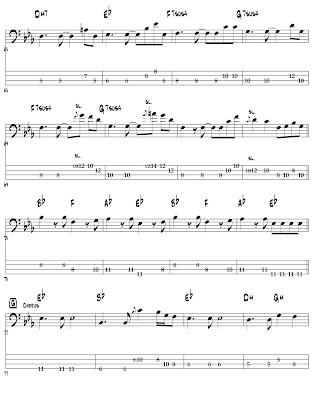
Weekly Basslines #242: Is She Really Going Out With Him ? (Joe Jackson)


"Is She Really Going Out with Him?" was one of the first songs Joe Jackson recorded with the Joe Jackson band, which included bassist Graham Maby, guitarist Gary Sanford, and drummer Dave Houghton. 

It was released in October 1978 as his debut single and was later included on Jackson's debut album, Look Sharp! 

"Is She Really Going Out with Him?" has been a mainstay of Jackson's live setlist since its release. Like many of Jackson's songs, "Is She Really Going Out with Him?" has been rearranged in live concerts to align with Jackson's shifting musical interests. These reworkings include an acoustic rendition and an a cappella “doo-wop” version, performances of which have both been released on Live 1980/86. An a cappella version of "Is She Really Going Out with Him?" was released as a single in 1988 in some European countries. 

"Is She Really Going Out With Him" was Joe Jackson's amusing commentary on hot girls hooking up with butt-ugly dudes. Jackson makes this clear in the marvelous opening line, "Pretty women out walking with gorillas down my street." 

In a Songfacts interview with Joe Jackson, he explained that the song was written with a humor that was lost on some listeners. 

Songfacts: …. one of your bigger hits, "Is She Really Going out With Him?" Was there a specific couple? I always wondered. 

Joe: Now, that is just one of those songs that started with the title. I heard that phrase somewhere and I thought that could be a kind of funny song about gorgeous girls going out with monsters. It just started from there. It was just a funny song, or supposed to be funny. It was a great surprise to me when some people interpreted it as being angry.


------------------------------------------------------------------------------------------------------------

Become a patron for only $2 per month and get access to the pdf transcription of this song (and 14 more Joe Jackson tunes), my YouTube transcription archive and much more. Take a look, it's worth it:


11/09/2019

Weekly Basslines #241: I Love The Sound Of Breaking Glass (Nick Lowe)


 “I Love The Sound Of Breaking Glass” was Lowe's highest charting hit in the UK, where it peaked at #7. The single was lifted from Lowe's debut solo album, “Jesus of Cool” from 1978.

Steve Goulding, Andy Bodnar and Bob Andrews – Lowe's session musicians – helped to compose this song. Lowe said: "That was a song which was sort of made up in the studio. I had the vague idea of the tune, and that's why in the writing credits, I cut the bass player and the drummer in on the song, because they made it, really. The drums and bass are really great on that song. Steve Goulding and Andy Bodnar used to play with Graham Parker And The Rumour, whose records I produced, and they played bass and drums on '(I Love the Sound of) Breaking Glass.' Their contribution was so great, I gave them a third each. In fact, I should have actually given Bob Andrews, who played piano on it, a taste of the record. The piano is so great."


-----------------------------------------------------------------------------------
Become a patron for only $2 per month and get access to the pdf transcription of this song, my YouTube transcription archive and much more. Take a look, it's worth it:


11/02/2019

Weekly Basslines #240: One More Cup Of Coffee (Bob Dylan)


This track from the 1975 album “Desire” tells the tale of a gypsy girl, and of the man who must leave her to enter the "valley below." Some critics see the song as a metaphor for Dylan's crumbling relationship with his then wife, Sara Lowndes, but it was a specific experience that inspired it.

When Dylan was 34 years old, he visited Saintes-Maries-de-la-Mer, France. While there he attended a gypsy celebration. The experience left a strong impression on him. "I'll never forget this one man played Russian roulette with five bullets in the chamber!" Dylan wrote of the experience. "Anyway, things went on and it was time for me to go. They said, 'What do you want Bob, as you're leaving us?' I just asked for a cup of coffee for the road.
They put it in a bag and they gave it to me. And I was standing there looking out to the ocean, and it was like looking at the valley below where I was standing."

Rob Stoner's bass contribution at the beginning of the song was because violinist Scarlet Rivera wasn't ready. Stoner recalled to Mojo magazine October 2012: "The beginning of 'One More Cup of Coffee' - that wasn't arranged for me to do a bass solo. Scarlet wasn't ready. Bob starts strumming his guitar - nothing's happening. Somebody better play something, so I start playin' a bass solo. Basically the run-throughs became the first takes."

The song develops its “gypsy” feel through using the “Andalusian cadence”. This is a harmonic minor chord progression adopted from flamenco music comprising four chords descending stepwise  i–VII–VI–V.  Dylan uses the progression in A harmonic minor: Am-G-F-E.


------------------------------------------------------------------------------------------------------------

Become a patron for only $2 per month and get access to the pdf transcription of this song, my YouTube transcription archive and much more. Take a look, it's worth it:


7/24/2019

Weekly Basslines #239: Out of the Blue (Roxy Music)

Roxy Music – The band of many bass players!

I counted seven different bass players during 1970 – 1983.

Graham Simpson was the first bass player and founding member of Roxy Music. He left the band after the first album had been finished.

Then there was Rik Kenton, who only played shortly with the band. He probably can be heard on the single “Virginia Plain” .

Sal Maida toured with the band and can be heard on the “Viva!” live album.

John Porter was a guitar player and friend of Bryan Ferry back at his college days. He played on “For Your Peasure” and on Bryan Ferrys first solo album.

John Wetton toured with Roxy Music and can be heard on the “Viva!” live album.

John Gustafson was a member of Roxy Music for four years and performed on three studio albums (Stranded,1973; Country Life,1974;  Siren, 1975), but did not always play on the live shows. His final record with the band, Siren, included their only American top 40 hit single, "Love Is the Drug".

Alan Spenner was the last one, who – according to Bryan Ferry – “would still be in the band if he hadn’t died, if the band hadn’t split up”.

This weeks transcription was requested by one of my Patrons and has originally been recorded for the “Country Life” album with John Gustafson playing the bass. For the transcription I chose a live version from 1976 recorded on tour in Sweden, where the bass can be heard excellently.


------------------------------------------------------------------------------------------------------------

Become a patron for only $2 per month and get access to the pdf transcription of this song, my YouTube transcription archive and much more. Take a look, it's worth it:

7/17/2019

Weekly Basslines #238: Shoot To Thrill - live from Donington (AC/DC)

This week I want to talk about the role of the bass guitar in different musical gengres.

AC/DC is widely known to have rather simple basslines, but is simple the same as easy?

I think there is a big misconception about "simple basslines". I will show you how complex simple basslines can be with Cliff Williams bassline to "Shoot to Thrill" in the live version from Donington.

Wikipedia says about Cliffs style:
"Williams role in AC/DC was to provide steady but basic basslines which followed the rhythm guitar of Malcolm Young, consisting mostly of eighth notes. His basslines were sometimes written by Malcom and Angus Young during composition, and at other times Williams developed them based on the other instrumental tracks. Williams said he plays "the same thing in every song, for the most part. In AC/DC's music, the song is more importantn than any individual's bit in it". He added that "complex [bass] lines wouldn't add anything to a guitar-oriented band like ours, so I try to create a bottom layer that drives what our guys are doing on top."

From my own experience I know that playing in a studio situation is mostly more restricted than playing live, but Cliff's live bassline brilliantly demonstrates how a simple bassline can be flourished and is still serving the song.

On YouTube you can find this isolated bass-track from "Live at Donington":


And here's the transcription of this bassline:


As you can see and hear Cliff Williams is a genius in playing simple but vivid and varied.

Here's the video with full band:


In summary I would say one of the most challenging tasks as a bassplayer is to find diversity in restraint, to serve the song and still play interesting basslines. In fact it is much easier to play without boundaries. So think about that, when you come up with a new bassline!

-------------------------------------------------------------------------------------------------------------

Become a patron for only $2 per month and get access to the pdf transcription of this song, my YouTube transcription archive and much more. Take a look, it's worth it:


7/09/2019

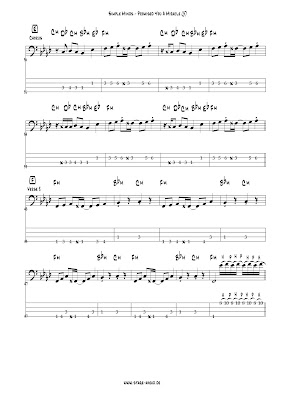
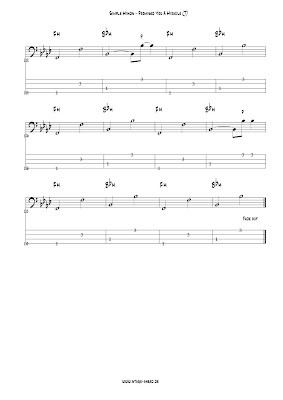
Weekly Basslines #237: Promised You A Miracle (Simple Minds)


-------------------------------------------------------------------------------------------------------------

Become a patron for only $2 per month and get access to the pdf transcription of this song, my YouTube transcription archive and much more. Take a look, it's worth it:
My Patreon Page

6/30/2019

Weekly Basslines #236: Summer (WAR)

It's hot in Germany. Today the temperature is up to 40° celsius! Nonetheless today I'm taking up the routine of posting basslines on my blog again after a hiatus of almost one year! But I'm starting relaxed and slowly with a tune that perfectly fits the moment:

'Cause it's summer
summertime is here

yes it's summer
my time of year....


Adjusted to the heat the corresponding bassline is a relaxed repeated 4-bar phrase:


So get into the Summer Vibe!