Here's the abbreviated live version:
9/15/2013
Weekly Basslines #117: Tubular Bells (Mike Oldfield)
Neil from New Jersey is always coming up with really interesting requests. Like this one. A favourite of mine since my childhood days I always wanted to transcribe this masterpiece, but never found the opportunity to do it. Now since the request is about a shortened live version Mike Oldfield did at the "Night Of The Proms" in 2006 I now have at least a starting point to go for the complete version in the near future.
Here's the abbreviated live version:
So Neil have fun with that!!!
Here's the abbreviated live version:
9/12/2013
Weekly Basslines #116: Get Lucky (Daft Punk)
This request came along with a donation from Mareen and is a perfect addition to the basslesson about the dorian mode of the previous post, since this tune is written in the dorian mode too.
Besides the scale itself the main thing one should learn about modes is the chord progressions it forms. In the last post I was talking about the i-IV-Progression as a very common progression in the dorian mode.
Here's a very famous example for this progression in the key of A-dorian:
Another popular dorian chord progression is the i-ii-iii-ii-Progression.
The famous example that I want to show you for this progression is in the key of F# dorian:
Get Lucky features another common progression in the dorian mode the i-iii-v-IV-Progression. It's in the key of B dorian:
The bass on this track was played by the great Nathan East on a 5-string bass and I have to admit that it really took me a while to figure out his really outstanding bassline with all the subtle rhythmic details correctly.
Besides the scale itself the main thing one should learn about modes is the chord progressions it forms. In the last post I was talking about the i-IV-Progression as a very common progression in the dorian mode.
Here's a very famous example for this progression in the key of A-dorian:
The famous example that I want to show you for this progression is in the key of F# dorian:
Get Lucky features another common progression in the dorian mode the i-iii-v-IV-Progression. It's in the key of B dorian:
The bass on this track was played by the great Nathan East on a 5-string bass and I have to admit that it really took me a while to figure out his really outstanding bassline with all the subtle rhythmic details correctly.
The video has a prolonged intro which i didn't transcribe.
So thanks again to Mareen for the donation and I hope you "get lucky" with my transcription!
9/10/2013
Basslesson: The Dorian mode (Part 1)
Basilio from Italy asked me if I could translate a prior post regarding the dorian mode into english and finally I got that managed. So here's my little workshop about the dorian mode in english:
The dorian scale is derived from the major scale:
When you rearrange the notes of a C-major scale starting from the second dregree (“D”) and proceed through it until that same note is reached one octave higher, you’ll be constructing the D-dorian scale.
The d dorian scale contains the same notes as the c-major scale, just in different order.
When you built the diatonic chords on the dorian scale, you’ll find that dorian belongs to the group of minor scales. The first chord (tonic) in D-dorian is D-minor.
The dorian scale is derived from the major scale:
When you rearrange the notes of a C-major scale starting from the second dregree (“D”) and proceed through it until that same note is reached one octave higher, you’ll be constructing the D-dorian scale.
The d dorian scale contains the same notes as the c-major scale, just in different order.
When you built the diatonic chords on the dorian scale, you’ll find that dorian belongs to the group of minor scales. The first chord (tonic) in D-dorian is D-minor.
In contrast to the aolian(or natural) minor scale the dorian scale has a major chord on the fourth degree (IV; sudominant) and the sixth degree happens to be a whole step above the dominant.
A trademark progression for the dorian scale is alternating between the minor tonic and the major subdominant chord. There are several songs which make use of that progression (i - IV).
We now want to construct the E-dorian scale. As the dorian scale is built on the second degree of a major scale, we go down a whole step from the E and take the D-major scale as a starting point.
Here are the diatonic chords of the E-dorian scale:
The i-Iv-progression in E-dorian consists of the chords E-minor (i, tonic) and A-major (IV, subdominant).
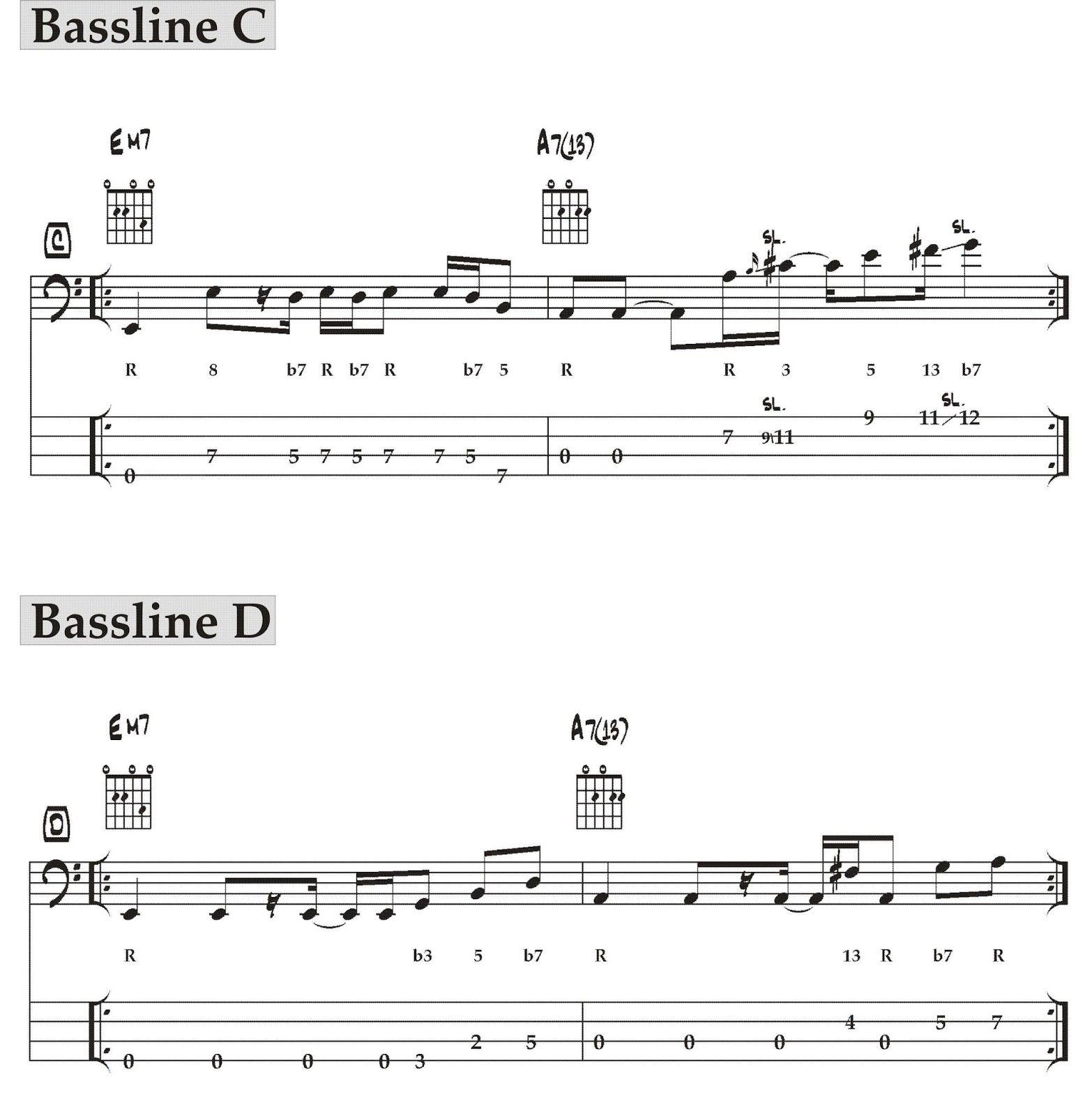
Often this progression is spiced up by adding a few “tension tones” to the plain triads. In our example the tonic will be played as a seventh-chord (Em7) and the subdominant gets the seventh and the “13”(A7/13), which is a sixth played an octave higher.
In the video I show you four different basslines over the i-IV-progression. The notes of the bassline are all derived from the chord-tones of the accompanying chords.
In the transcriptions of the basslines I denoted the function of every note related to the respective chords by using these short cuts:
R = root of the chord
3 = major third
b3 = minor third
5 = fifth
b7 = minor seventh
13 = octave of the sixth (6)
3 = major third
b3 = minor third
5 = fifth
b7 = minor seventh
13 = octave of the sixth (6)
The i-IV-progression in the dorian mode is really a very common progression.
Here are a few examples of songs which use this progression:
Santana - Oye como va (Am - D)
Allman Brothers - In Memory of Elizabeth Reed (Am9 - D)
Billy Cobham - Red Baron (Gm7 - C9)
9/08/2013
Weekly Basslines #115: Call Me The Breeze (J.J. Cale; Lynyrd Skynyrd)
In order to catch up with the various requests I received during my absence here's another one I did on this weekend.
This request came from one of my former students, who would like to add this J J Cale classic to the setlist of her band to honour the "King of Cool" who sadly passed away this july.
Because she wasn't sure if they like to do the original or the Lynyrd Skynyrd version I transcribed both.
The original version can be found on J.J. Cale's debut album "Naturally" from 1972.
It is in fact a 24-bar blues, which is derived from a very simple 12-bar blues by doubling the lenghth of each chord:
This request came from one of my former students, who would like to add this J J Cale classic to the setlist of her band to honour the "King of Cool" who sadly passed away this july.
Because she wasn't sure if they like to do the original or the Lynyrd Skynyrd version I transcribed both.
The original version can be found on J.J. Cale's debut album "Naturally" from 1972.
It is in fact a 24-bar blues, which is derived from a very simple 12-bar blues by doubling the lenghth of each chord:
8 bars tonic (I),
4 bars subdominant (IV), 4 bars tonic (I),
2 bars dominant (V), 2 bars subdominant (IV) and 4 bars tonic (I).
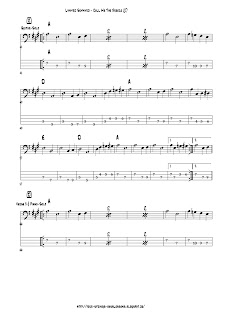
The Lynyrd Skynyrd version can be found on their second studio album "Second Helping" from 1974:
During my research for YouTube-Videos for this song I stumbled across a very unique version of "Call Me The Breeze" from a band called "Spiritualized". Take a look:
9/07/2013
Weekly Basslines #114: My Generation (Live at Leeds-Version) (The Who)
Quiet recently returned from my summer vacation I found my mailbox overflowing with requests from bass players all over the world. I'm amazed, a big thank you for the donations and I will immediately put the headphones on to transcribe all your requests.
The biggest request (and biggest donation) came from a regular reader of my blog. He asked me if I could transcribe the 15 minute long version of "My Generation" from The Who's famous "Live at Leeds" album. Well I started a few days ago, but it's quiet understandable that it'll take a while and so I decided to do it as a kind of Work-In-Progress post here. As the live version of that song is a medley of different songs I will start with the main song today and consecutively add the remaining parts. An Canadian LP pressing denotes the sections as follows:
So here's the first part, the song "My Generation" itself:
Saturday 14th
Here comes the first addition to the transcription started last week: "See Me, Feel Me" & "Higher":
The biggest request (and biggest donation) came from a regular reader of my blog. He asked me if I could transcribe the 15 minute long version of "My Generation" from The Who's famous "Live at Leeds" album. Well I started a few days ago, but it's quiet understandable that it'll take a while and so I decided to do it as a kind of Work-In-Progress post here. As the live version of that song is a medley of different songs I will start with the main song today and consecutively add the remaining parts. An Canadian LP pressing denotes the sections as follows:
a. My
Generation
b. See Me,
Feel Me (We're Not Gonna Take It)
c. Higher
d.
Overbridge
e. Coming
Out To Get You
f. Underture
g. Driving
Four
So here's the first part, the song "My Generation" itself:
Saturday 14th
Here comes the first addition to the transcription started last week: "See Me, Feel Me" & "Higher":
to be continued.....
If you like The Who or John Entwistles very special way of playing the bass guitar, here's another transcription I've done:
Subscribe to:
Posts (Atom)


.jpg)